Service lifecycle management for charities: 4 stages to improve service delivery
- Helen Vaterlaws

- Oct 28, 2025
- 8 min read
Updated: Jan 3

Charities are under pressure to do more, faster – without burning out staff, stretching volunteers beyond reason, or confusing the people you exist to support.
One way through that pressure is to stop thinking in isolated projects and start thinking in service lifecycles – a way of working that reduces pressure on staff and volunteers and makes charity service delivery clearer and fairer for the people you support.
This piece shares a practical view of service lifecycle management for charities – what it is, the four stages, and what it looks like in a complex, multi-service organisation.
It’s written for leaders juggling operations, governance, fundraising and lived experience, who want a clearer line of sight from strategy to the day-to-day reality of services.
What is service lifecycle management in charities?
When we talk about service lifecycle management in charities, we mean taking responsibility for the whole life of a service: from first understanding need, through design and testing, into live delivery and continuous improvement and finally to conscious decisions to retire, merge, scale or reinvent that service.
Done well, this covers all channels – digital, in-person, telephone and volunteer-led – with people who use your services, carers and volunteers at the centre throughout.

For someone on the receiving end, that looks like:
fewer hand-offs
less “who do I call next?” confusion
more consistent, joined-up experiences, regardless of which door they come in through.
And crucially, no single team owns the lifecycle. It only works when there is:
– a shared language about where a service is on its journey
– clear decision points
– cross-functional ownership of outcomes, not just outputs.
What are the stages of a charity service lifecycle?
There are lots of formal design frameworks out there. This is a charity-friendly version, built from the practical realities of service delivery:
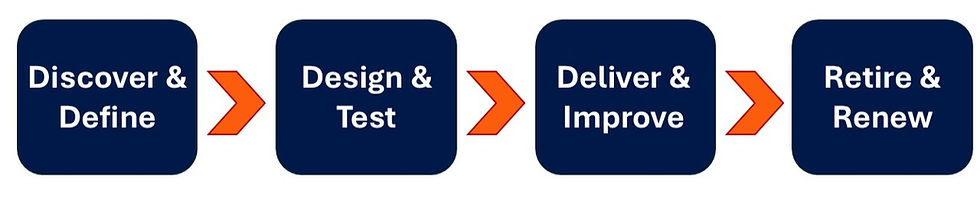
Discover & Define – see the whole ecosystem
Design & Test – turn insight into viable services
Deliver & Improve – treat go-live as the start, not the end
Retire & Renew – manage the whole portfolio, not one service at a time
Together, these stages give you a practical way to improve charity service delivery without adding yet another heavyweight process.
This four-stage lifecycle is a charity-focused adaptation of common service-design frameworks (like the Double Diamond), with an explicit ‘Retire & Renew’ stage for portfolio decisions.
Click the arrow to walk through each stage.
Stage 1 – Discover & Define: how do charities see the whole ecosystem?
What this stage is for
This is where you decide what problem you’re actually trying to solve and where your organisation can add the most value. That means looking beyond a single helpline, website or programme and asking:
What do people who use our services, carers and volunteers actually need and value?
Where are the pressure points today?
How does our work sit alongside statutory services, local groups and other charities?
The output should be a prioritised problem statement and a clear view of your role in the wider system – not a list of pre-chosen solutions.
How to do it
✔️ Blend mixed-methods data and lived experience: Use operational data, complaints, safeguarding logs, qualitative insight, and direct conversations with people who use your services and volunteers.
✔️ Map the whole system on one page: Show how someone moves through health, social care, benefits, peer support and your services. Highlight duplication, gaps and invisible hand-offs.
✔️ Co-produce the problem, not just the answer: Involve people with lived experience and volunteers in shaping the problem statement, not just sense-checking a draft. When people recognise their reality in how you’ve framed the issue, trust rises sharply.
🚩Watch-outs🚩
Framing need as “demand to be managed” rather than “what matters to people” and rushing to a solution because funding cycles are tight.
Stage 2 – Design & Test: how do you turn insight into viable services?
What this stage is for
Here you turn insight into a small number of service options, then test what actually works in real-world conditions. The goal is not a perfect blueprint. It’s to discover:
what is deliverable by staff and volunteers
what is fundable and sustainable
and what genuinely improves life for the people you serve.
How to do it
✔️ Co-design across the system: Bring together people with lived experience, carers, volunteers, frontline staff, fundraising, insight, digital and safeguarding. Use short, focused sessions rather than one huge workshop.
✔️ Create simple service blueprints: Map user and volunteer journeys, data flows, risks, hand-offs and cost drivers on a page or two. Keep the language human, not technical.
✔️ Set clear decision gates: Agree in advance: What makes a pilot a “go”, “grow”, “pause” or “stop”? What metrics and feedback will you use? Who makes the call and when?
🚩Watch-outs🚩
Designing in a development silo and then “throwing it over the wall” to operations or volunteers.
The way through is psychological safety and shared ownership: give people space to surface tensions between delivery, safeguarding and fundraising, and use evidence to make joint decisions and strengthen service offerings.
Stage 3 – Deliver & Improve: how do you keep charity services evolving?
What this stage is for
This is where services are delivered day in, day out – calls answered, emails sent, groups supported, content updated. The mindset shift is simple but profound:
Go-live is the start of ongoing improvement, not the end of a project.
How to do it
✔️ Name clear service owners: Make it obvious who is accountable for quality, safeguarding, data and improvement.
✔️ Set up cross-functional governance that enables, not blocks: Keep decision forums lean. Bring together operations, volunteering, digital, fundraising, safeguarding and finance with a shared view of the same data.
✔️ Use simple dashboards: Track reach, equity, outcomes, complaints themes and qualitative feedback on one page. Enough to see patterns, not so much that people drown in metrics.
✔️ Normalise learning loops: Make it routine for frontline staff and volunteers to say “this isn’t working” – and to be part of fixing it. Short 30/60/90-day reviews after any change can work well.
Where AI or automation is in the mix, treat it as a way to reduce admin and surface patterns, not to replace human judgement, particularly in safeguarding or emotionally complex work.
🚩Watch-outs🚩
“Launch and leave”: no time, money or headspace for improvement after a project ends.
Stage 4 – Retire & Renew: when should a charity retire or redesign a service?
What this stage is for
The most neglected stage is often the last one: Retire & Renew.
Not every service should run forever. Some need to scale, some to merge, some to be redesigned from scratch – and some need to end so something better can take its place. This stage is about treating that reality as a planned part of the lifecycle, not as failure.
How to do it
✔️ Schedule regular portfolio reviews: Look across all services and pilots using pre-agreed criteria: strategic fit, impact, equity, cost and lived-experience feedback.
✔️ Plan transitions with care: If a service will change or close, design the transition with people who use it and those who deliver it. Decide how you will handle risk, redirect people to better options, and communicate clearly.
✔️ Shift thinking from outputs to outcomes: Ask: what difference is this service making now, compared with what else we could do with the same resource?
🚩Watch-outs🚩
Hiding retire/renew decisions in the margins instead of treating them as part of normal governance.
Where does AI fit in the service lifecycle?
AI is one option inside the charity service lifecycle, not a separate strategy.
In Discover & Define AI tools can summarise existing data and feedback so humans can spot patterns faster.
In Design & Test, you can prototype AI-supported steps (for example, assisted drafting or triaging routine tasks) in a small pilot.
In Deliver & Improve AI might automate some admin or highlight risk patterns, while people keep judgement, safeguarding and relationships.
A simple rule of thumb:
If a step relies on nuance, consent or safeguarding, keep a human in the loop and treat AI as assistive, not a replacement.
You can connect this directly with your AI adoption work – for example, by using our Map → Measure → Mobilise approach for any AI pilot and aligning it with your existing service lifecycle.
Guiding principles: how do you put the lifecycle into practice?
Across all four stages, these five principles make the service lifecycle real inside a charity or nonprofit:
Lived experience at the centre, all the way through: People who use your services and volunteers are not an add-on; they are partners in shaping problems, options, decisions and how services end.
Shared power at key decision gates: Co-produce the decisions, not just the outputs. Agree the questions, options and criteria together before you lock in a direction.
Governance that enables, not obstructs: Clear ownership, simple processes and cross-functional forums that pull everyone in the same direction instead of generating parallel decision tracks.
Learning and iteration as routine, not heroic: Make it normal to adapt services based on feedback, complaints themes and frontline insights – weekly if needed, not just in annual reviews.
Evidence-led investment: Use data, evaluation and feedback to decide what to start, scale, pivot or retire. Keep equity, safeguarding and sustainability alongside volume and cost.
These principles give you a practical way to improve nonprofit services without drowning in frameworks.
What does service lifecycle management look like in your organisation?
Applied in your context, service lifecycle management for charities would mean four practical shifts:
One shared lifecycle model across teams: Everyone uses the same language – Discover & Define, Design & Test, Deliver & Improve, Retire & Renew – from frontline teams to the exec and board.
A visible portfolio of services: At any point, you can see what’s in discovery, pilot, scale or review. That makes trade-offs transparent and stops “hidden services” growing unnoticed.
Decision-making that balances impact, equity, safeguarding and sustainability: Fundraising, insight, digital, operations and lived experience are at the same table when you decide what to start, scale, pivot or stop.
Co-production at key decision points, not just at the edges: People with lived experience and volunteers are part of the decisions that shape services, not just the feedback after the fact. And live services are continually improved, not launched and left.
For exec teams and boards, this means fewer surprises, clearer choices and a stronger line of sight from strategy to what changes in everyday life for the people you serve.
Quick Q&A: service lifecycle management in charities
Q1. What is service lifecycle management for charities?
Service lifecycle management for charities is the practice of managing a service from first understanding need, through design and testing, into live delivery and finally retiring or redesigning it. It helps leaders see the whole service, not just separate projects, and make better decisions about where to focus limited time, money and people.
Q2. What are the stages of a charity service lifecycle?
A simple charity service lifecycle has four stages: Discover & Define, where you understand need and your role; Design & Test, where you co-design and pilot options; Deliver & Improve, where you run services and iterate based on feedback; and Retire & Renew, where you review, scale, merge or close services based on evidence.
Q3. How can service lifecycle management improve charity service delivery?
Service lifecycle management improves charity service delivery by making work more joined-up and intentional. It reduces handoffs and confusion for service users, clarifies ownership for staff and volunteers, and gives leaders a structured way to prioritise improvements, manage risk and make evidence-led decisions about where to invest.
Q4. When should a charity retire or redesign a service?
A charity should consider retiring or redesigning a service when outcomes or equity measures are declining, demand or context has changed, there is a better alternative, or the service no longer fits strategy or budget. Building regular portfolio reviews into your lifecycle makes these decisions planned and transparent instead of reactive.
Q5. Where does AI fit in charity service lifecycle management?
AI fits into charity service lifecycle management as one design option, not a goal in itself. Charities can use AI to summarise data, automate routine admin and surface patterns, especially in the Design & Test and Deliver & Improve stages. Safeguarding decisions, relational work and grey-zone judgement calls should stay with people, with AI used to support rather than replace them.
Change doesn’t start with a workshop; it starts with one honest conversation.
Note: Examples are for illustrative purposes only; no official affiliation with the organisations or tools mentioned is claimed. AI systems can be unpredictable, so always keep personal or sensitive data out of third-party tools and ensure your implementation follows your own organisation’s data protection policies.


